Description
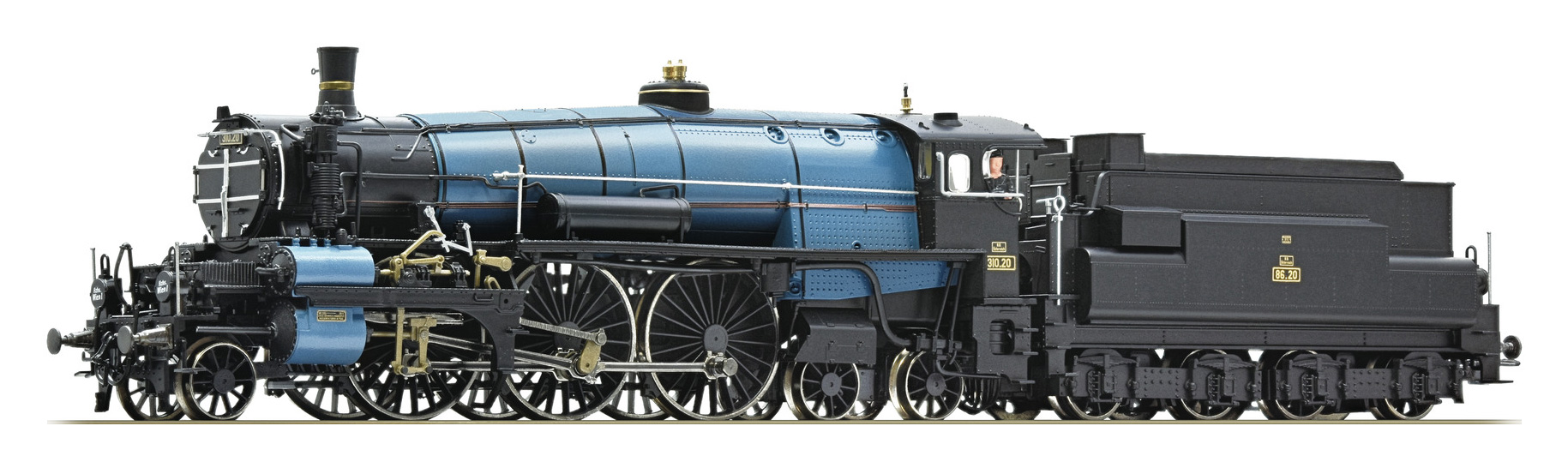
Steam locomotive 310.20 of the Austrian Federal Railways.
Edition model!
Drive on two axles of the tender and via cardan shaft on all three locomotive driving axles.
■ Finely-detailed chassis
■ Filigree reproduction of the control
■ Steam locomotive valve gear with NEM finescale metal spoke wheels
■ Tender wheel sets with greater wheel flange height
■ Opening smokebox doors
■ Many separately attached details
■ Retrofittable smoke generator
Due to increased train weights in express train traffic, the most influential designer for Austrian steam locomotive construction, Ing. Dr. h.c. Karl Gölsdorf, developed a new express locomotive with the wheel arrangement 1'C2' in 1906. This, compared to the Pacific type popular in many countries, was an "inverted" axle arrangement, which made it possible to accommodate a large upright boiler with a wide grate. Together with the weighty four-cylinder compound engine, it was possible to create a high-performance locomotive despite the low Austrian axle load limit of only 14.5 t. This locomotive is considered by many railway enthusiasts to be the most beautiful steam locomotive in Austria.
Whereas the first 11 engines were delivered in wet steam design, the other 90 examples of this type were put into service as series 310 superheated steam locomotives and used by the kkStB mainly on the Nordbahn, the Franz-Josefsbahn and the Westbahn between Vienna and Salzburg as a high-quality passenger train service.
The "Russian Iron" was an alternative to primed and painted sheet metal in the early railway eras, but also represented an aesthetic element. It was only used around locomotive areas with high heat radiation, such as the panelling on the boiler and cylinder.
The black and white photos at our disposal suggest that locomotives of the 310 series also received "Russian Iron" panelling. Images in colour also support this assumption. In terms of colour design, the black-painted smoke chamber panelling provides striking accents. This contributes to the highly attractive appearance of this unusual locomotive design.
Specifications
Digital-DecoderNo
Digital InterfaceNEM 652 digital decoder socket
Flywheel massYes mm
Navigable minimum radius358 mm
Length over buffer248 mm
Anzahl angetriebene Achsen5
Anzahl Achsen mit Haftreifen2
CouplerShaft NEM 362 with KK-Kinematik at tender
Steam can be addedYes
IlluminationMicro-light bulb
HeadlightsDouble headlights, alternating with travel direction
Vorbild (Land)Austria
Reference data
Manufacturer’s item no.7100012
EAN9005033068851
ReleasedMärz 2024
ScaleH0 (1:87)
EraII
Power systemDC
Railway companyBBÖ
Market value
Coming soon
The modellbahn·fokus market value index will in future show reference values for both available and discontinued models — transparently derived and continuously updated.


Comments from members (0)
No comments on this model yet – be the first.
Only signed-in members can write comments. Sign in now
Report an error or suggest an addition
Do you know this model better? The editors review every note.
Please sign in to suggest a correction or an addition.