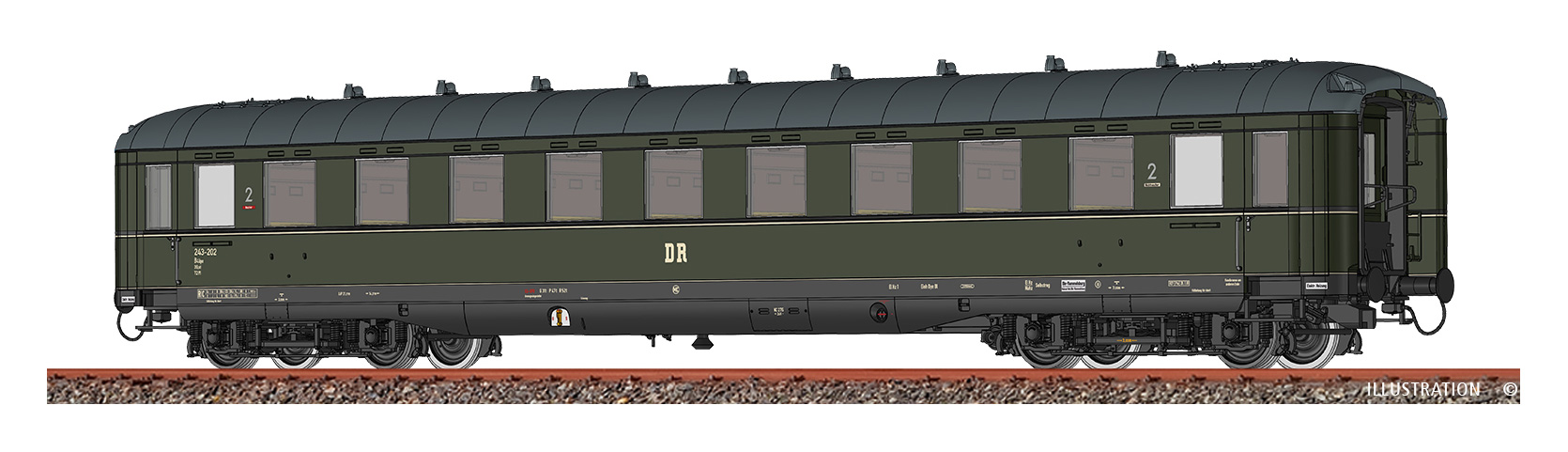
Description
DR B4üpe Passenger Car
Operating Number: 243-202
MODEL DETAILS
Metal axle holders
Prototype axle bearing covers
Brake shoes at wheel level
Individually applied steps and ladders
Extra applied axle brake linkage
Multi-part brake system
Variant-appropriate interior fittings
Extra applied spring assemblies
Complete reproduction of the vehicle floor
Interior lighting prepared or installed
Close coupling mechanism
INFORMATION ABOUT THE PROTOTYPE
With the Type 39 express train cars, the Reichsbahn aimed to finally usher in the age of high-speed rail travel and increase the speeds of passenger trains. To achieve this, the factors that caused air turbulence in previous car designs had to be reduced. As with the Type 35 carriages, the Type 39 carriages relied heavily on welding technology. However, the designers' main focus was on achieving the smoothest possible outer shell. The areas under the frame and around the bogies had previously been a major source of air resistance, so it was logical to cover these parts with side panels. The eponymous skirt was thus invented. The design also featured other sophisticated details for its time. For example, the entrance doors were positioned on the outside. An elaborate folding mechanism ensured that the doors opened together with the side panels, despite the pivot point being located deep within the carriage. The side window frames were also flush with the outer panel. To accommodate the necessary window recesses, the carriages were made approximately 40 mm wider below the sill. The Deutsche Reichsbahn planned to procure over 1,000 carriages in various configurations. Due to the war, only 543 production vehicles were delivered between 1939 and 1940, comprising 103 AB4ü-38, 310 C4ü-38, 65 ABC4ü-39, and 65 BC4ü-39 models. Parallel to the passenger car production, Mitropa commissioned a revision of the WR4ü-35 design from the railway carriage industry. Unlike the passenger cars, however, this did not result in a completely new design. Instead, the outward-positioned entrance doors were adapted, and the frame skirt was added. The inward-set windows and the different window height were retained. Due to the late delivery of the cars, their use was rather limited until the war-related suspension of express train services. Many cars were therefore stored in supposedly safe railway stations for protection against destruction. That this was not always successful is evidenced by several cars that were written off as war losses. The vehicles that survived the war unscathed largely remained in West Germany. Besides some confiscations by the occupying powers, the German Federal Railway (DB) largely refurbished the carriages for its newly established express train network. At the time, these skirted carriages were the most modern and comfortable passenger cars on German railways. With the increasing deliveries of the new 26.4 m carriages from the second half of the 1950s onward, the DB increasingly used the carriages in regular express trains. It would be until the mid-1970s before the last of the skirted carriages were withdrawn from the DB's rolling stock and relegated to reserve depots for military and troop transport. The carriages remaining with the East German State Railway (DR) were incorporated into modernization programs in the early 1960s and converted into so-called "modernization carriages." Furthermore, some carriages remain with the Austrian Federal Railways (ÖBB) and the French National Railway (SNCF).
Specifications
Digital InterfaceFür Decoder-Einbau vorbereitet
CouplerShaft NEM 362 with KK kinematics
Length over buffer244 mm
Interior Fittingswith arranged interior
Interior Fittingswith interior lighting
Reference data
Manufacturer’s item no.51072
EAN4012278510729
ReleasedQ4/2024
ScaleH0 (1:87)
EraIII
Power systemDC
Railway companyDR
Market value
Coming soon
The modellbahn·fokus market value index will in future show reference values for both available and discontinued models — transparently derived and continuously updated.


Comments from members (0)
No comments on this model yet – be the first.
Only signed-in members can write comments. Sign in now
Report an error or suggest an addition
Do you know this model better? The editors review every note.
Please sign in to suggest a correction or an addition.